St John Hospital and Medical Center Program Family Medicine Residency

Whether you wear green and crack open a Guinness or not, in that location'southward no fugitive St. Patrick's Solar day revelry. Celebrated annually on March 17, the holiday commemorates the titular saint's expiry, which occurred over 1,000 years ago during the fifth century. But our modern-day celebrations often seem like a far cry from the day's origins. From dying rivers green to pinching one another for non donning the solar day's traditional hue, these St. Patrick'due south Twenty-four hours community, and the day's general development, have no dubiety helped it endure. Simply, to celebrate, nosotros're taking a look back at the holiday's fascinating origins.
Who Was Saint Patrick?
Known as the patron saint of Republic of ireland, Patrick was born in Roman Britain. At the age of 16, he was kidnapped, enslaved, and brought to the Emerald Isle. While he did escape, Saint Patrick is credited with returning to Ireland and bringing Christianity with him effectually 432 Advert, which is probable why he'south been made the country'south national apostle. Roughly 30 years later, Patrick died on March 17, but, from monasteries and churches to Christian schools, he clearly left an enduring legacy behind.
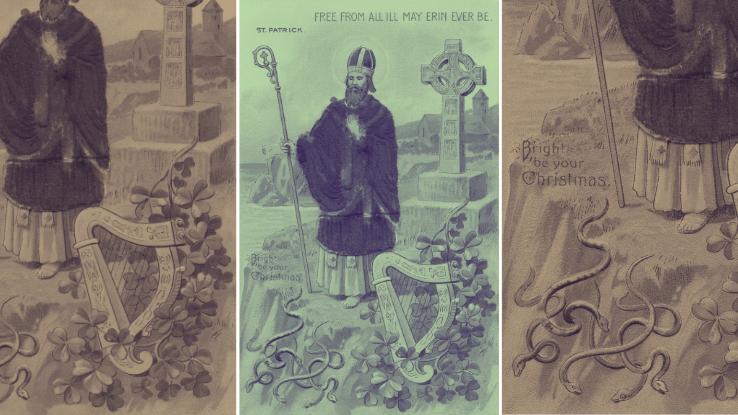
As happens later on one'due south death, a number of legends cropped upward effectually the saint. The most famous? Supposedly, he drove the snakes out of Ireland, chasing them into the sea later on they attacked him during a xl-solar day fast. Did the Christian missionary actually accomplish this feat? It's unlikely, according to Nigel Monaghan, keeper of natural history at the National Museum of Ireland in Dublin. "At no time has there always been any suggestion of snakes in Ireland," Monaghan told National Geographic. "[There was] zilch for St. Patrick to banish." Another (much more plausible) story notes that Saint Patrick used a shamrock to illustrate the Holy Trinity — hence the three-leafed clover's connection to the holiday.
To celebrate Saint Patrick's life, Ireland began commemorating him around the ninth or 10th century with religious services and feasts. Since March 17 falls during the Lent — a Christian season that prohibits the consumption of meat, among other things — revelers would nourish church services in the morning and celebrate the saint in the afternoon. Best of all, they received special impunity to eat Irish bacon, potable, and be merry.
Opposite to popular belief, the first St. Patrick's Day parade was thrown in North America in 1601. And, no, it wasn't held in Boston. In fact, the Irish vicar of what was then a Castilian colony — and what is now present-day St. Augustine, Florida — helmed the celebration. In 1737, Irish gaelic folks in Boston held what some considered to exist the city's first St. Patrick's Day parade — though it was more of a walk up Tremont Street, really. And, in 1762, Irish soldiers stationed in New York City held their ain march to observe St. Patrick'due south Day. At present, parades are an integral role of the revelry, especially in the United states of america where millions of people flock to the over 100 parades held annually throughout the country.
When the Cracking Spud Famine hit in the mid-1800s, nearly 1 million Irish people emigrated to the U.South. Many of these Irish gaelic immigrants faced discrimination based on the religion they practiced — largely Roman Catholicism — and their unfamiliar accents. While organizations, such as the New York Irish Assistance society, tried to foster a sense of customs and Irish gaelic patriotism on St. Patrick'due south Day, revelers were portrayed poorly in the media, furthering the discrimination the displaced Irish community faced.
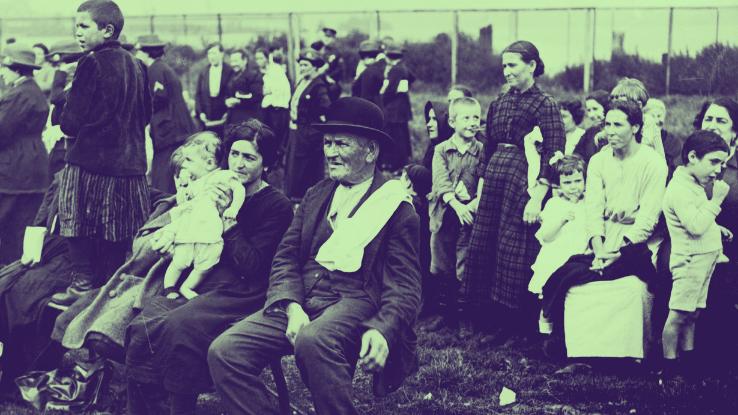
But this all changed when Irish Americans recognized their own political ability. St. Patrick's Mean solar day parades, and other events that celebrated Irish gaelic heritage, became pop — and even drew the attention of political hopefuls looking to capture the Irish American vote. Nowadays, the pride has continued to swell, so much so that both people of Irish descent and those without any Irish heritage partake in the festivities. In the U.S., massive celebrations are held in major cities similar Chicago, Boston, New York City, and Savannah.
Outside of the States, Canada, Commonwealth of australia, and, of course, Republic of ireland go all out, too. In fact, upward until the 1970s, the solar day was a traditional religious vacation in Ireland. Irish laws had mandated pubs to close on March 17. But, in the 1990s, Ireland decided to utilize the holiday to drive tourism. Each twelvemonth, the holiday attracts about one million people to the country — and, in particular, to Dublin, which is home to Guinness, Ireland's famous stout.
Why Dark-green? And Why Corned Beef?
So, why is green associated with the holiday? It seems like the obvious linkage is Ireland'south apt nickname, the Emerald Isle, which references the country'due south lush greenery. Merely at that place'south more to it than that. For one, at that place'south the shamrock — a symbol of St. Patrick — and green is one of the colors that's been consistently used in Republic of ireland's flags. Notably, dark-green also represented the Irish gaelic Catholics who rebelled against Protestant England. Perhaps surprisingly, blue was the original color associated with the holiday upwards until the 17th century or so.
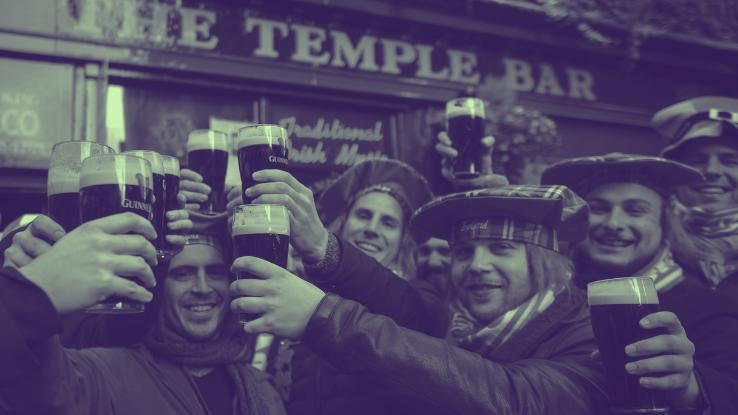
And, equally y'all may know from St. Patrick'due south Days by, there'south as well a long-standing tradition of being pinched for not wearing dark-green. This potentially irksome trend started in the U.S. "Some say [the color green] makes yous invisible to leprechauns who will pinch you lot if they tin see y'all," ABC News x reports. Our advice? Make sure yous're wearing something light-green on the day — or practice your dodging maneuvers until you're a regular Spider-Man.
"Many St. Patrick's Day traditions originated in the U.S.," Mental Floss points out. "Like the compulsion to dye everything from our booze to our rivers dark-green." And the traditional repast of corned beef and cabbage is no exception. In fact, corning is a way to preserve beef, and, while information technology dates back to the Middle Ages, the practice became popular amongst Irish gaelic immigrants living in New York City in the 1800s.
"Looking for an alternative [to table salt pork, or Irish bacon], many Irish immigrants turned to the Jewish butchers in their neighborhoods," Mental Floss reports. "There, they constitute kosher corned beef, which was not only cheaper than salt pork at the time, simply had the aforementioned salty savoriness that made it the perfect commutation." Served up with cabbage, potatoes, carrots, and traditional Irish soda breadstuff, this repast is a must-have every March. Often, revelers will pair their corned beef dinner with a Guinness stout. In fact, it was estimated that 13 million pints of Guinness were consumed worldwide on March 17, 2017. And, in the U.Due south. alone, folks spent over $half dozen billion celebrating St. Patrick's Day in 2020.
Source: https://www.reference.com/history/holidays-101-celebrate-st-patrick-s-day-fc3bececede55417?utm_content=params%3Ao%3D740005%26ad%3DdirN%26qo%3DserpIndex

Enregistrer un commentaire for "St John Hospital and Medical Center Program Family Medicine Residency"